czego szukasz?
W tłumiku absorpcyjnym perforowany rdzeń stanowi jedynie część układu akustycznego. Materiał otaczający rdzeń ma bezpośredni wpływ na hałas wydechu, jakość dźwięku, stabilność termiczną, trwałość uszczelnienia i długotrwałą sprawność tłumika.
Materiał ten jest powszechnie znany jakouszczelnienie tłumika.
W zależności od konstrukcji układu wydechowego i rynku, ten sam element może być również opisany jakomateriał uszczelniający tłumika,uszczelnienie tłumika wydechowego, uszczelnienie tłumika, materiał uszczelnienia układu wydechowego, wypełnienie akustyczne, wełna tłumiąca lub materiał tłumiący układ wydechowy.
Firma BSTFLEX dostarcza i opracowuje materiały uszczelniające odporne na wysokie temperatury do tłumików motocyklowych, układów wydechowych samochodów osobowych, tłumików wyścigowych, tłumików przemysłowych, generatorów i innych układów wydechowych.
Odkryj pełną gamęmateriały uszczelniające tłumik.
Typowy tłumik absorpcyjny zbudowany jest w oparciu o stosunkowo prostą konstrukcję:
Przepływ spalin → rura perforowana → warstwa z włókien ochronnych → uszczelnienie akustyczne → powłoka zewnętrzna
Spaliny przepływają przez perforowany rdzeń. Energia akustyczna przechodzi przez perforacje i wnika w otaczający materiał włóknisty.
Zamiast polegać wyłącznie na komorach lub przegrodach ograniczających, wypełnienie zamienia część energii akustycznej na bardzo małe ilości ciepła poprzez tarcie wewnątrz struktury włókna.
Aby system mógł działać dalej, opakowanie musi pozostać:
termicznie stabilny,
wystarczająco odporny,
odporny na erozję spowodowaną pulsacją spalin,
prawidłowo zapakowane wokół rdzenia,
i jest w stanie zachować strukturę włókien po wielokrotnym nagrzewaniu i chłodzeniu.
Dlatego wybór materiału uszczelniającego tłumika wydechowego wyłącznie na podstawie temperatury roboczej rzadko jest wystarczający.
Uszczelnienie tłumika spełnia kilka zadań jednocześnie.
Otwarta struktura włókien pochłania energię dźwięku generowaną przez impulsy wydechowe. Jest to szczególnie ważne w tłumikach przelotowych i wyczynowych, w których przepływ gazu odbywa się przez perforowaną rurę centralną.
Stan opakowania może mieć wpływ nie tylko na ciśnienie akustyczne, ale także na dźwięk wydechu.
Świeże wypełnienie zazwyczaj zapewnia bardziej kontrolowany, mniej metaliczny dźwięk wydechu. W miarę jak włókna ulegają degradacji, kompresji, migracji lub zanikają, tłumik może stać się zauważalnie ostrzejszy i głośniejszy.
Warstwa wypełnienia oddziela gorącą perforowaną rurę od obudowy tłumika.
Mimo że uszczelnienie tłumika jest przede wszystkim materiałem akustycznym, jego właściwości termiczne wpływają na temperaturę obudowy i trwałość sąsiadujących elementów.
Stabilne uszczelnienie zmniejsza bezpośrednie obciążenie akustyczne i termiczne powłoki zewnętrznej. Dobrze zaprojektowany system uszczelnień może również zmniejszyć pogorszenie jakości tłumika spowodowane wibracjami.
Nie ma jednego materiału uszczelniającego tłumika, który byłby idealny dla każdego układu wydechowego.
Na wybór materiału wpływają takie czynniki, jak temperatura, prędkość gazu, typ silnika, przewidywany odstęp między przeglądami, poziom hałasu, geometria tłumika i metoda produkcji.
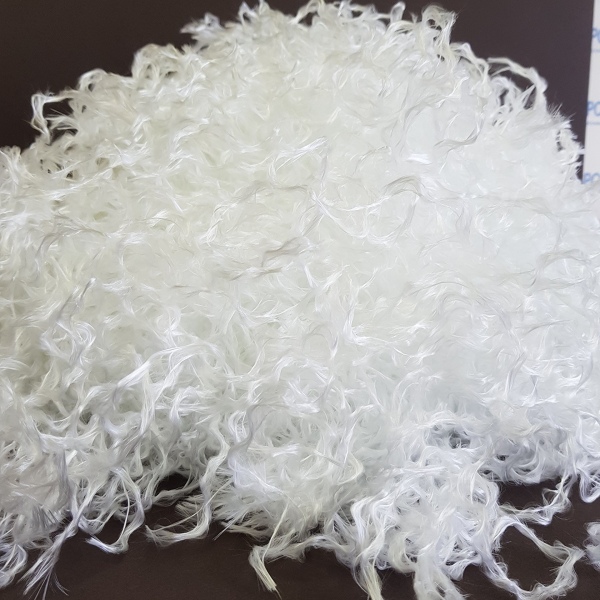
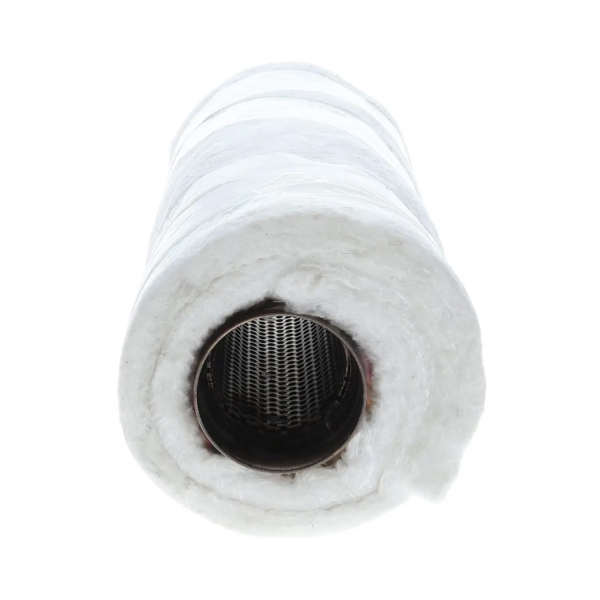
Włókno szklane pozostaje jednym z najczęściej stosowanych materiałów w tłumikach absorpcyjnych.
Łączy niską gęstość objętościową z dużą powierzchnią włókien, co zapewnia dobrą absorpcję dźwięku bez nadmiernego zwiększania wagi.
Typowe formy obejmują:
luźna przędza z włókna szklanego,
włókno szklane ciągłe,
teksturowane włókno szklane,
maty z włókna szklanego,
poduszki pakowe z włókna szklanego,
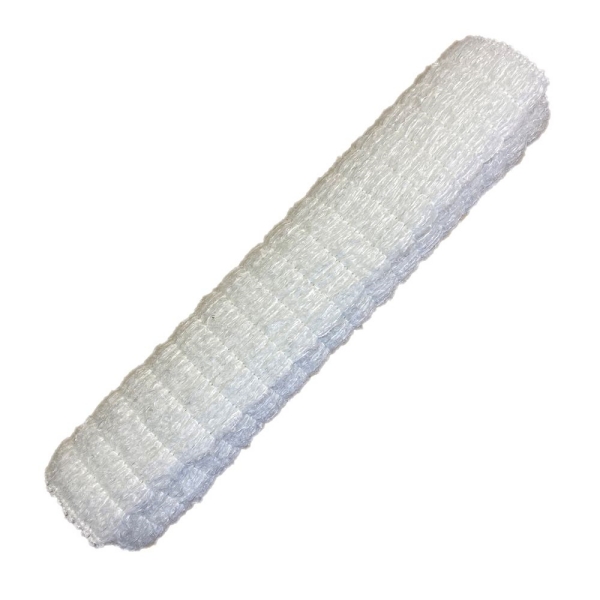
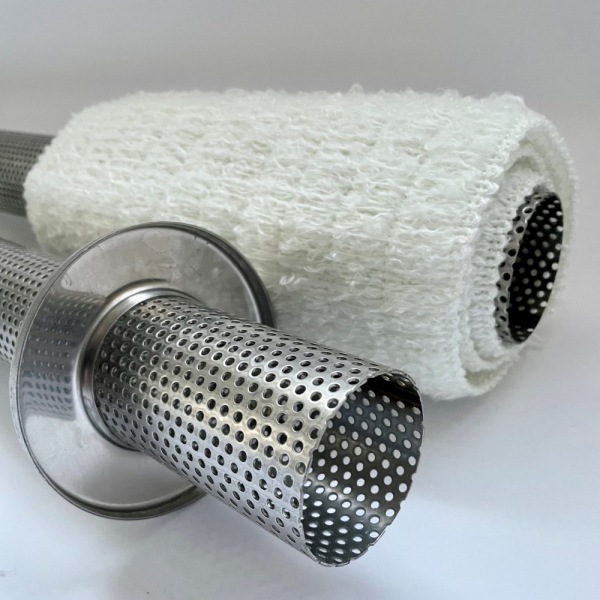
gotowe skarpety uszczelniające,
i włókno szklane umieszczone w workach z siatki szklanej.
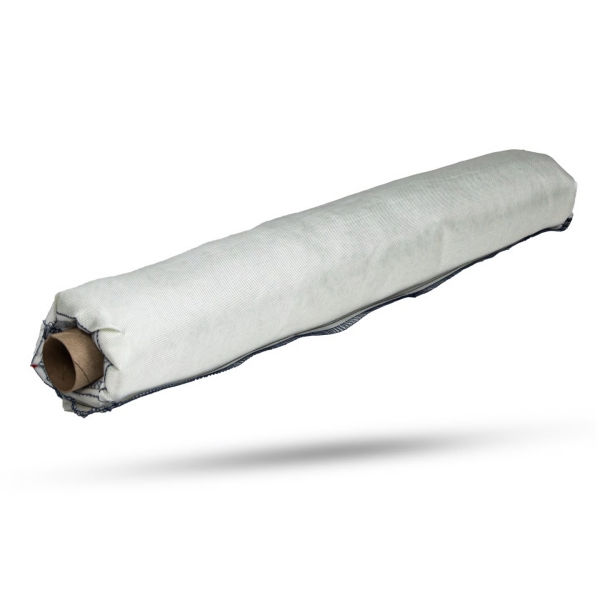
BSTFLEX produkujeWłókno szklane, tłumik, worek z siatki szklanejdo zastosowań, w których kontrolowana instalacja i retencja włókien są preferowane zamiast luźnego pakowania.
Uszczelnienia z włókna szklanego są powszechnie wybierane w następujących przypadkach:
tłumiki motocyklowe,
Tłumiki do pojazdów ATV i UTV,
samochodowe układy wydechowe o wysokiej wydajności,
tłumiki zamienne,
układy wydechowe wyścigowe,
i wiele tłumików absorpcyjnych OEM.
Jego główną zaletą jest równowaga pomiędzy wydajnością akustyczną, wagą, łatwością produkcji i ceną.
Wełna stalowa spełnia nieco inną funkcję.
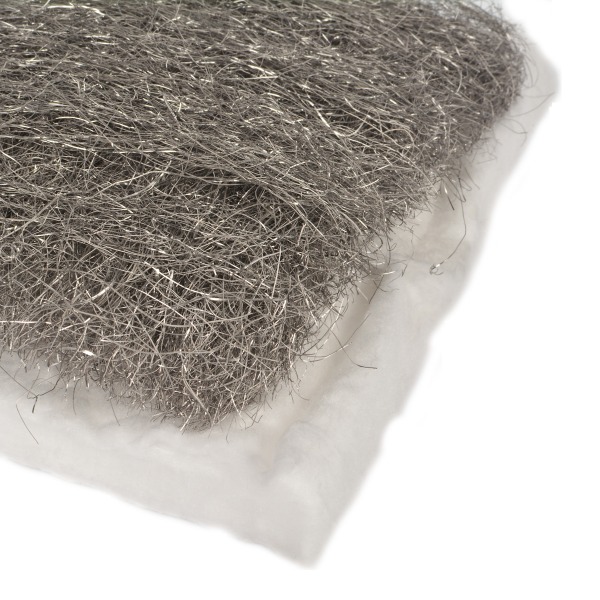
Można go stosować jako materiał uszczelniający, ale w wielu układach wydechowych o dużej wydajności montuje się go bezpośrednio wokół perforowanej rury jako warstwę ochronną.
Typowy układ wygląda następująco:
Rdzeń perforowany → wełna stalowa → wypełnienie z włókna szklanego → obudowa tłumika
Warstwa stali nierdzewnej pomaga chronić miękkie włókna akustyczne przed:
bardzo gorące gazy spalinowe,
impulsy o dużej prędkości,
turbulencje wokół perforacji,
narażenie na płomienie,
i stopniowe wydmuchiwanie włókien.
Konstrukcja ta jest szczególnie przydatna w wymagających motocyklach, pojazdach wyścigowych, pojazdach z turbodoładowaniem i układach wydechowych o dużej wydajności.
Z tego powodu porównywanie włókna szklanego i wełny ze stali nierdzewnej, jak gdyby można było zastosować tylko jeden materiał, jest czasami mylące. W wielu tłumikach pełnią one funkcje uzupełniające.
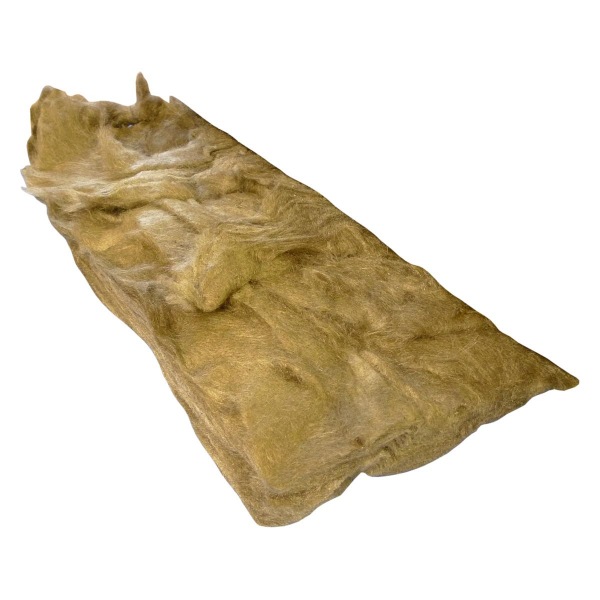
W przypadku gdy temperatura spalin jest niezwykle wysoka, można rozważyć zastosowanie włókna ceramicznego.
Uszczelnienia tłumików z włókien ceramicznych są atrakcyjne ze względu na swoją odporność na wysokie temperatury i stosunkowo niską przewodność cieplną.
Możliwe zastosowania obejmują:
high-temperature industrial silencers,
heavy-duty engine exhaust systems,
certain generator exhaust assemblies,
thermal-intensive exhaust equipment,
and special mufflers operating beyond the practical range of conventional glass fiber.
However, the highest temperature material is not automatically the best acoustic material.
Density, fiber diameter, resilience, vibration resistance, handling requirements, and long-term fiber stability must also be evaluated.
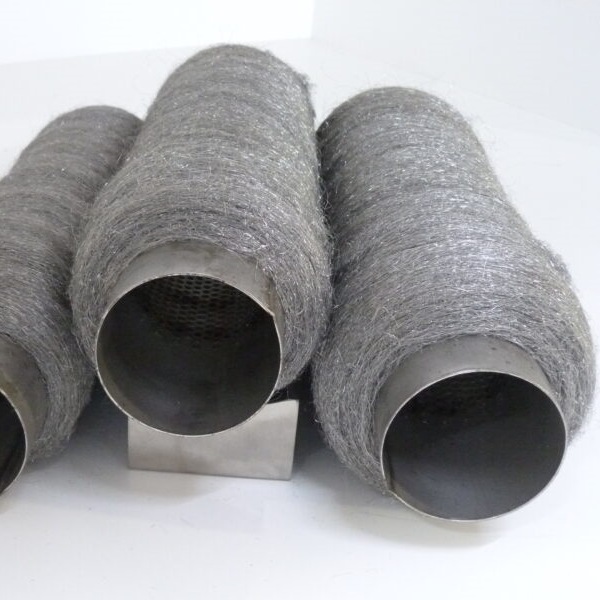
Basalt fiber provides another option between conventional glass fiber and more specialized high-temperature materials.
Produced from volcanic basalt rock, continuous basalt fibers can provide:
good thermal resistance,
mechanical stability,
chemical resistance,
vibration resistance,
and useful acoustic performance.
Basalt muffler packing can therefore be considered for automotive, motorcycle, heavy-duty, or industrial exhaust systems where designers want a mineral-fiber solution with elevated thermal capability.
| Packing Material | Primary Strength | Typical Position | Suitable Applications |
|---|---|---|---|
| Fiberglass | Efficient acoustic absorption | Main packing layer | Motorcycle, automotive, performance exhaust |
| Stainless Steel Wool | Heat and erosion protection | Around perforated core or as metallic packing | Racing, turbo, high gas velocity exhaust |
| Ceramic Fiber | Extreme-temperature capability | Main or supplementary insulation layer | Industrial and severe-temperature silencers |
| Basalt Fiber | Thermal and mechanical durability | Main acoustic packing layer | Heavy-duty, automotive and industrial exhaust |
The correct construction may combine two or more materials rather than using a single fiber throughout the silencer.
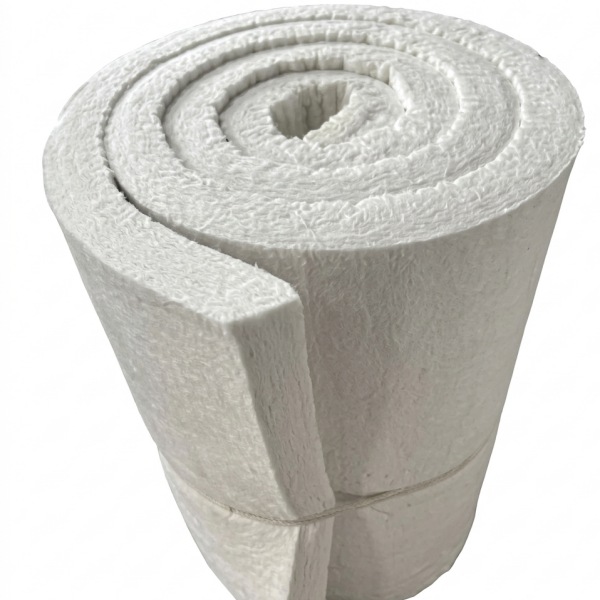
Two mufflers using exactly the same fiber can perform differently simply because the material was installed at different densities.
This is one of the most overlooked aspects of exhaust muffler packing.
If the fiber mass is insufficient, several problems can develop:
reduced acoustic absorption,
rapid fiber movement,
localized empty areas,
increased exhaust noise,
accelerated blowout.
The fibers may also redistribute under vibration and exhaust pulsation.
Over-compression creates another set of problems.
When fibrous material is compressed excessively, the void structure needed for acoustic energy dissipation changes.
The result can be:
poorer sound absorption in certain frequency ranges,
increased silencer weight,
difficult assembly,
reduced fiber resilience,
and unnecessary material consumption.
The goal is therefore not to put the maximum possible amount of packing inside the muffler.
The objective is to achieve a controlled and repeatable packing density suitable for the muffler geometry and target acoustic performance.
Muffler packing works in one of the harshest environments on a vehicle.
The material may experience thousands of heating and cooling cycles together with vibration and rapidly fluctuating exhaust pressure.
Several deterioration mechanisms can occur.
High-velocity exhaust gases passing through perforations gradually attack exposed fibers.
This is often called fiber blowout.
Continuous exposure to elevated temperature can reduce fiber resilience and alter the packing structure.
Vibration can cause loose packing to migrate or compact.
The silencer may develop areas with insufficient material even when the total amount of packing originally installed was correct.
Condensation, oil residue, incomplete combustion products, and other deposits can affect the condition of the acoustic fibers.
A theoretically suitable material may still fail prematurely if it is packed unevenly or installed at the wrong density.
Muffler packing deterioration is not always visible from outside the silencer.
Several operating changes can indicate that the material should be inspected.
Common signs include:
A noticeable increase in exhaust volume
The muffler gradually becomes louder because the effective acoustic mass has decreased.
A sharper or metallic exhaust note
When the packing layer becomes thin, sound energy interacts more directly with the metal shell.
Fibers coming from the tailpipe
Visible strands or particles at the outlet may indicate packing migration or blowout.
Hot spots on the muffler casing
Loss or movement of the internal packing can create uneven thermal distribution.
Rattling or internal movement
This can indicate loose material or deterioration of internal components.
Motorcycle silencers place especially high demands on packing material because the available volume is limited while exhaust temperatures and pulse velocity can be high.
For this reason, motorcycle exhaust packing normally needs to combine:
strong acoustic absorption,
low weight,
good thermal stability,
resistance to vibration,
easy repacking,
and controlled fiber retention.
Both two-stroke and four-stroke engines use packed silencers, but their operating environments differ considerably.
Two-stroke exhaust packing can be affected heavily by oil, combustion residue, and frequent repacking cycles.
Four-stroke performance exhausts may expose the material to higher sustained temperatures and aggressive exhaust pulses.
Selecting packing purely by motorcycle type is therefore insufficient. Muffler construction and engine operating conditions should also be considered.
Performance exhaust manufacturers often need to reduce sound without introducing excessive backpressure.
Straight-through absorption mufflers are useful in this situation because the exhaust path remains relatively open.
The acoustic packing surrounding the perforated core becomes a critical component.
Depending on the application, manufacturers may specify:
continuous fiberglass packing,
stainless steel wool core protection,
composite stainless/fiberglass systems,
basalt fiber,
or specialized high-temperature fibers.
For racing exhaust systems, packing retention becomes particularly important because high gas velocities can rapidly damage exposed loose fibers.
Industrial silencers operate under a different set of requirements.
Applications can include:
diesel generators,
gas engines,
compressors,
turbines,
exhaust treatment equipment,
heavy machinery,
power generation systems,
and industrial ventilation or acoustic control systems.
In these installations, designers may prioritize:
continuous operating temperature,
acoustic absorption over a specified frequency range,
long maintenance intervals,
fiber stability,
corrosion resistance,
and repeatable packing density.
Industrial buyers therefore often purchase muffler packing by engineering specification rather than simply selecting a consumer repacking kit.
Manufacturers normally have several ways to introduce fiber into a silencer.
Loose fibers or strands allow considerable flexibility during assembly.
They work well where the muffler geometry varies or packing is performed manually.
The challenge is maintaining consistent density from one muffler to another.
Mats provide more predictable thickness and make material handling easier during production.
They are especially suitable when the silencer has a regular cylindrical geometry.
A measured amount of fiber is enclosed inside a lightweight retaining fabric or mesh.
This allows manufacturers to control fiber mass before installation.
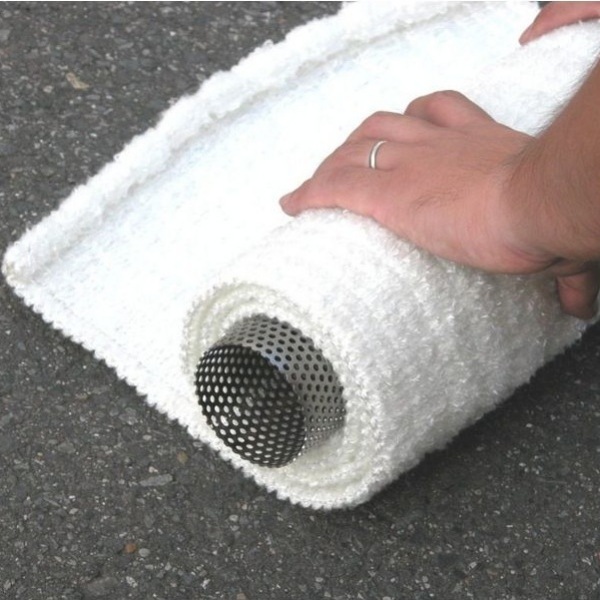
A tubular packing assembly can be fitted around the perforated core, reducing installation time and helping maintain circumferential coverage.
BSTFLEX develops customized packing formats including fiberglass-based assemblies for OEM exhaust production.
A purchase specification should contain more information than simply:
“Fiberglass muffler packing.”
For repeatable production, buyers should consider supplying:
| Specification Item | Why It Matters |
|---|---|
| Fiber material | Determines thermal and mechanical behavior |
| Silencer internal diameter | Defines available packing space |
| Perforated core diameter | Determines required packing thickness |
| Muffler length | Determines fiber quantity |
| Target packing density | Influences acoustic performance |
| Continuous exhaust temperature | Determines material suitability |
| Peak temperature | Identifies short-duration thermal exposure |
| Engine type | Helps evaluate exhaust environment |
| Packing format | Loose fiber, mat, pillow, sock or custom assembly |
| Annual quantity | Determines manufacturing and packaging method |
When these parameters are available, the packing can be engineered around the silencer rather than supplied as a generic bulk fiber.
Manual loose packing creates several variables.
One operator may install more material than another. Distribution around the perforated tube may also vary.
Preformed systems reduce this variability.
A packing sock, bag, pillow, or measured mat can provide:
defined material weight,
more uniform circumferential distribution,
reduced fiber handling,
shorter assembly time,
cleaner production,
improved batch repeatability.
For medium- and high-volume exhaust manufacturing, those manufacturing benefits can be as important as the thermal properties of the fiber itself.
A practical starting point is to identify the dominant failure risk.
Consider fiberglass as the primary acoustic layer.
Consider a stainless steel wool or metallic mesh protection layer before the main fiber packing.
Evaluate ceramic or other elevated-temperature fibers.
Consider materials and packing forms with stronger dimensional stability and controlled retention.
Consider preformed socks, pillows, mats, or custom packing assemblies rather than uncontrolled loose fill.
BSTFLEX manufactures high-temperature thermal and acoustic materials for exhaust systems and can support both replacement packing and OEM silencer production.
Available development options can include:
fiberglass muffler packing,
glass fiber silencer packing,
stainless steel wool packing,
ceramic fiber packing,
basalt-based packing,
loose fiber,
mats,
rolls,
packing bags,
packing pillows,
tubular packing socks,
and customized preformed assemblies.
Sizes, packing weight, fiber combination, retaining construction, and packaging can be developed according to customer drawings, samples, or silencer dimensions.
For applications requiring easier assembly and improved fiber containment, see theFiberglass Muffler Packing Sock with Woven Glass Mesh Bag.
For additional material options, visit theBSTFLEX Muffler Packing category.
There is no universal best material. Fiberglass is widely used because of its acoustic efficiency and weight, stainless steel wool is effective for protecting packing near the perforated core, while ceramic and basalt fibers may be selected where higher temperature capability is required.
Yes. Fiberglass is one of the most common acoustic materials used in absorption-type exhaust silencers because its fibrous structure provides efficient sound absorption while remaining relatively lightweight.
It can be used alone in some designs, but stainless steel wool and fiberglass often perform different functions. Stainless steel wool can protect the inner packing from exhaust erosion, while fiberglass provides the principal acoustic absorption layer.
Packing can escape because of fiber erosion, excessive gas velocity, damaged retaining mesh, incorrect packing density, thermal degradation, or deterioration around the perforated core.
Not necessarily. Excessive compression can reduce the open fiber structure needed for effective acoustic absorption. Packing density should be controlled rather than maximized.
There is no fixed interval for every exhaust system. Replacement frequency depends on exhaust temperature, engine type, riding conditions, packing material, gas velocity, silencer design, and operating hours.
Tak. Istnieje możliwość dostarczenia uszczelnienia OEM zgodnego ze średnicą rdzenia, średnicą korpusu, długością tłumika, docelową wagą uszczelnienia, specyfikacją materiału, wymaganiami temperaturowymi i preferowanym formatem instalacji.
Podczas projektowania układu wydechowego najwięcej uwagi poświęca się widocznej obudowie tłumika, ale materiał ukryty między obudową a perforowanym rdzeniem w znacznym stopniu decyduje o zachowaniu akustycznym tłumika.
Prawidłowo zaprojektowanymateriał uszczelniający tłumikanie powinny po prostu przetrwać upału.
Musi zachować właściwe proporcje pomiędzy strukturą włókien, gęstością, pochłanianiem dźwięku, odpornością na erozję i spójnością montażu.
W przypadku standardowych tłumików motocyklowych i samochodowych, włókno szklane pozostaje jednym z najbardziej wszechstronnych rozwiązań. W przypadku wymagających warunków pracy układu wydechowego, wełna stalowa nierdzewna, włókno ceramiczne, włókno bazaltowe lub kombinacje wielowarstwowe mogą wydłużyć jego żywotność.
Dla producentów układów wydechowych OEM kolejnym krokiem nie jest po prostu wybór włókna.
Definiuje to prawidłowośćukład uszczelnienia tłumika wydechowegodla geometrii tłumika, temperatury spalin, celu akustycznego i metody produkcji.
Firma BSTFLEX zajmuje się produkcją i dostosowywaniem materiałów uszczelniających tłumiki do układów wydechowych motocykli, samochodów, samochodów wyścigowych, generatorów, łodzi i przemysłu.
Skontaktuj się z firmą BSTFLEX, podając wymiary tłumika, temperaturę roboczą, wymagany format opakowania i roczną ilość w celu doboru materiałów i opracowania próbek.

No.10, Chuangxin North Road, Nanshan Park, Ningguo Economic and Technological Development Zone, Ningguo City, Anhui Province, China
tel/Whatsapp : 0086-15856303740
e-mail : sales@bstbraidedsleeve.com
Skype : vanesa-cheng